DSK Mobile – Mobility Hub
Year
2026
My role
Product Designer
Timeline
2 months
Team
Product Owner, SEM, QA, and market stakeholders
Overview
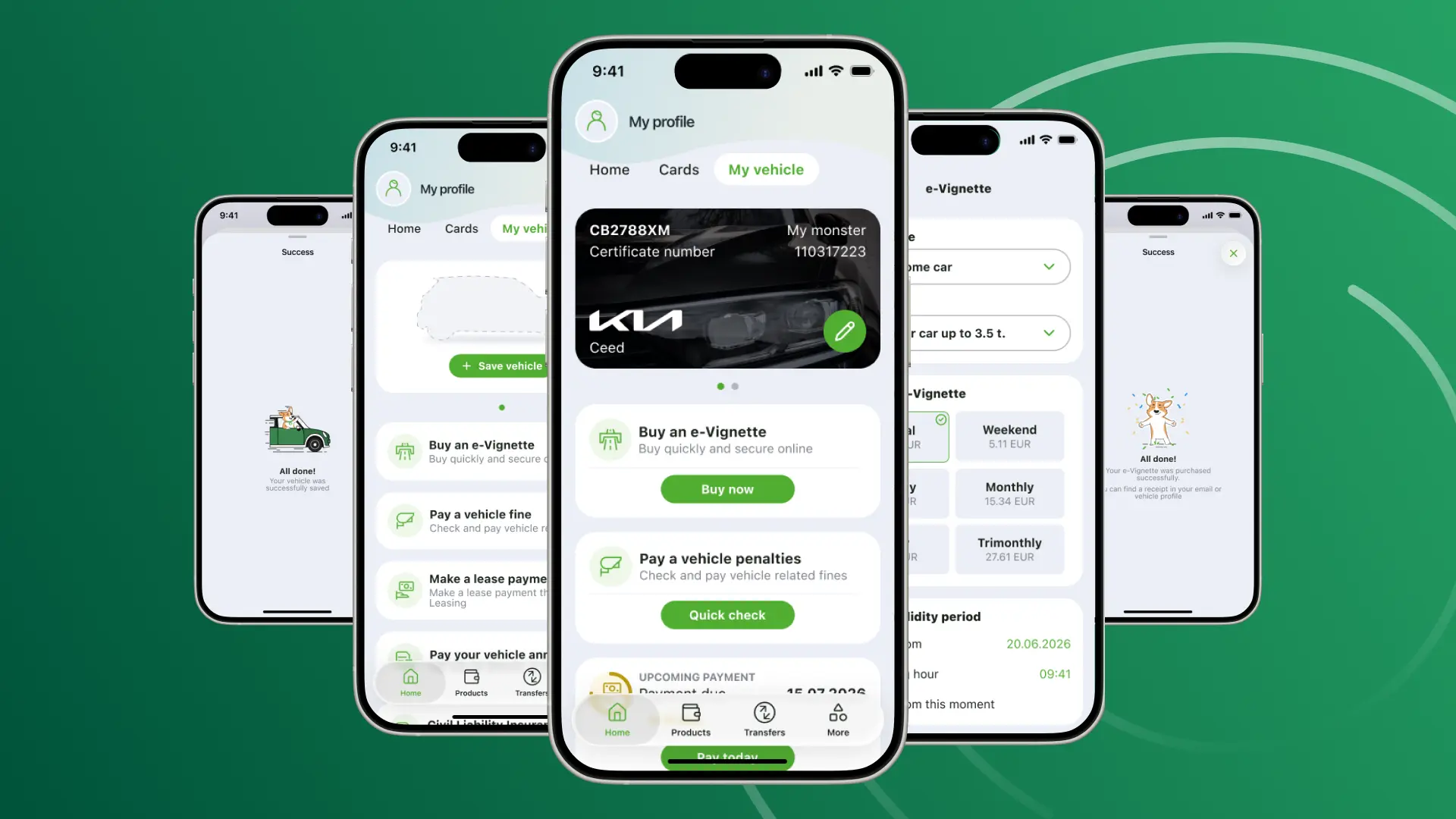
Mobility Hub is a feature of DSK Mobile that allows the bank’s customers to manage their vehicle-related obligations in one place.
My role in the project was to design the overall customer experience, from the initial kickoff meetings with stakeholders, to interviews that validate highly detailed workflows ready for development.
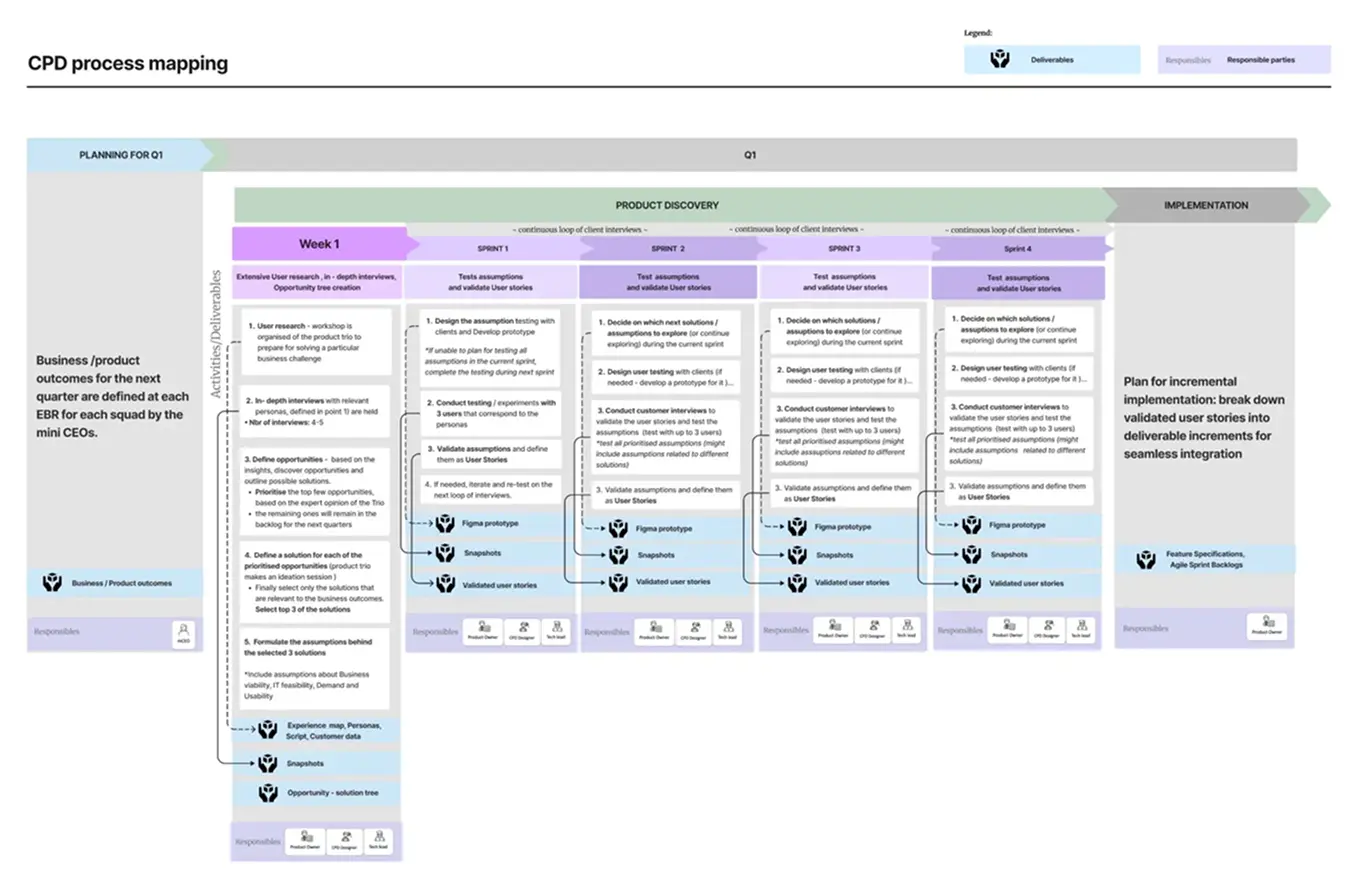
As part of the CPD (Continuous Product Discovery) process, together with the product owner, the SEM (technical consultant), and myself (product designer), we had to identify all user pain points and determine whether users would want this feature before it was released.
The challenge
Customers who own a personal or company vehicle have to deal with a long list of obligations. Each obligation is handled on a different website, in a different app, or at a service counter, and reminders arrive via email, SMS, or Viber, if they arrive at all.
Why this matters?
DSK Mobile is an app that people open every day, and it’s the natural place to pay any vehicle obligation. For the bank, there are three main goals:
- Increase engagement in the app by 20 to 30%.
- Increase transactions made through the app by 30%.
- Go fully digital for these services by the end of the year.
For customers, it meant fewer missed deadlines, fewer fines and one less app to install.
Research approach
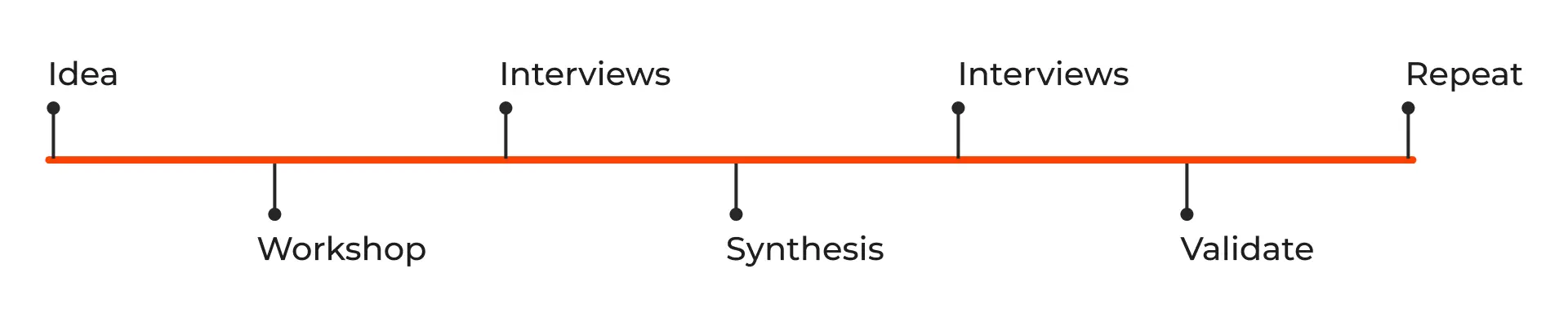
We worked in a continuous product exploration mode. The process began with a workshop to define the business outcome, followed by in-depth interviews, a summary of potential solutions in the form of a decision tree, and then weekly cycles of prototyping and testing hypotheses with real customers.
Each cycle ended with validated user stories that the team could incorporate into the development plan.
So we conducted around 10 in-depth interviews with DSK Bank customers who use the app regularly, ranging from those who are very confident in using mobile banking to those who rarely open the app.
Two questions guided us through the research:
- Do customers want these services inside their bank at all?
- Which services matter most, and what should we build first?
What we heard
The answer to the first question was a resounding “yes.” Customers don’t want to download and sign up for yet another app, and they already trust the bank with their money.
What they want in return is a brief and clear explanation of how their vehicle data is processed and whether it is shared with external partners.
“I don’t want to download and register in other apps. That’s why I see value in having these services in the banking app I open every day.”
Some of the pain-points that come out first
- Lack of proactive reminders. Deadlines are easily missed, and 3 out of 5 participants in a group have driven with an expired vignette.
- Everything is scattered. Invoices and notifications arrive via email, SMS, and Viber, and each payment is made in a different place.
- There is no unified overview of what is owing and when.
- Uncertainty regarding payments. People check their banking app after paying elsewhere to make sure the money has been transferred, and they wanted proof they could show later.
- Significant difficulties for consumers less experienced with digital technology, who still pay at gas stations or at the counter.
Two personas, two different needs
As a result of the analysis, two personas were created based on real participants.
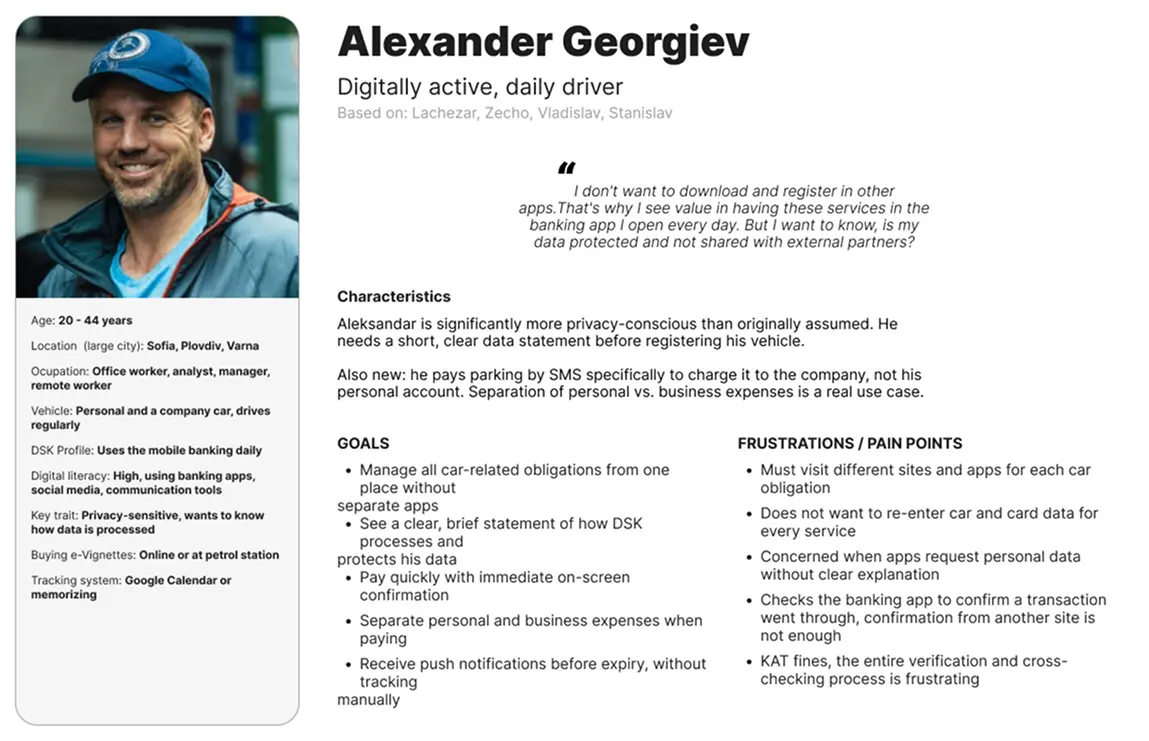
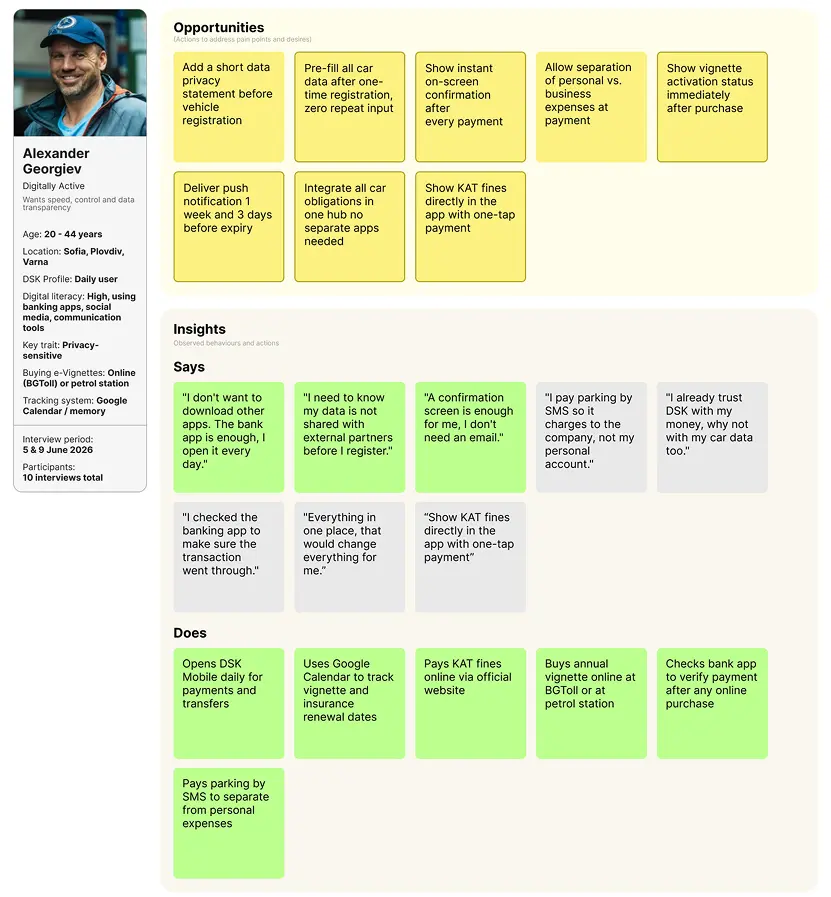
Alexander – the daily driver who actively uses digital technologies.
He opens the DSK Mobile app every day, keeps track of renewal dates in Google Calendar, and buys vignettes online.
He wants speed and control:
- Pre-filled vehicle information after a one-time registration
- Immediate confirmation after every payment
- One-tap payment of traffic fines
- The ability to separate personal and business expenses.
He is also sensitive to privacy issues and won’t register his vehicle without knowing how his data is handled.
Persona:
Snapshot:
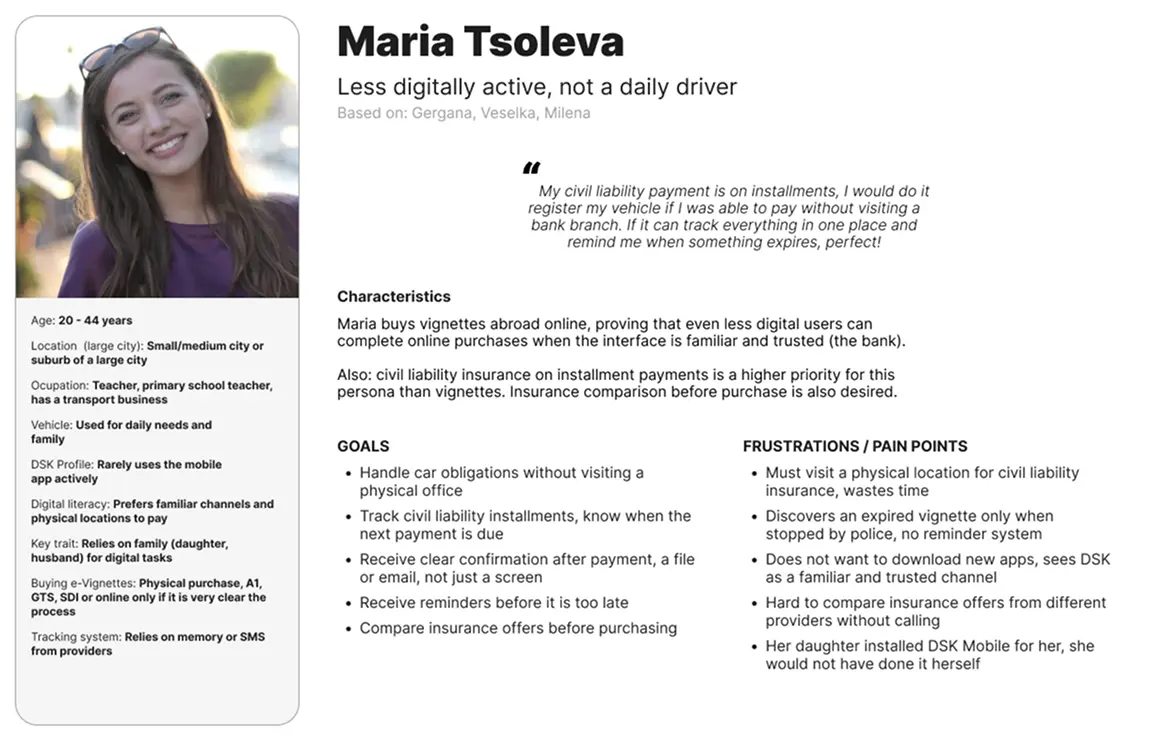
Maria – the less digital occasional driver
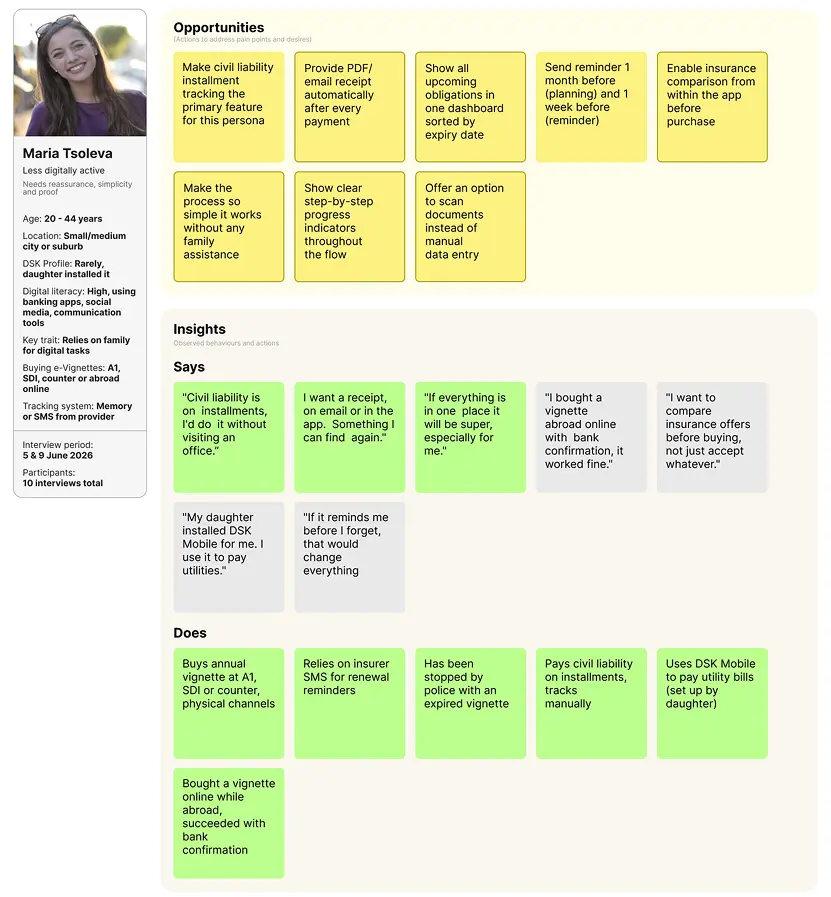
Her daughter installed the DSK Mobile app for her, and she uses it mainly to pay utility bills.
She buys highway toll stickers at the counter, relies on text messages from her insurance company, and has been pulled over by the police for having an expired toll sticker.
Her priority is her auto liability insurance, which she wants to pay in installments without having to visit an office.
She needs reminders before it’s too late and a receipt she can find again—either by email or in the app.
“If it can track everything in one place and remind me when something expires, perfect!”
Persona:
Snapshot:
From insights to an opportunity solution tree
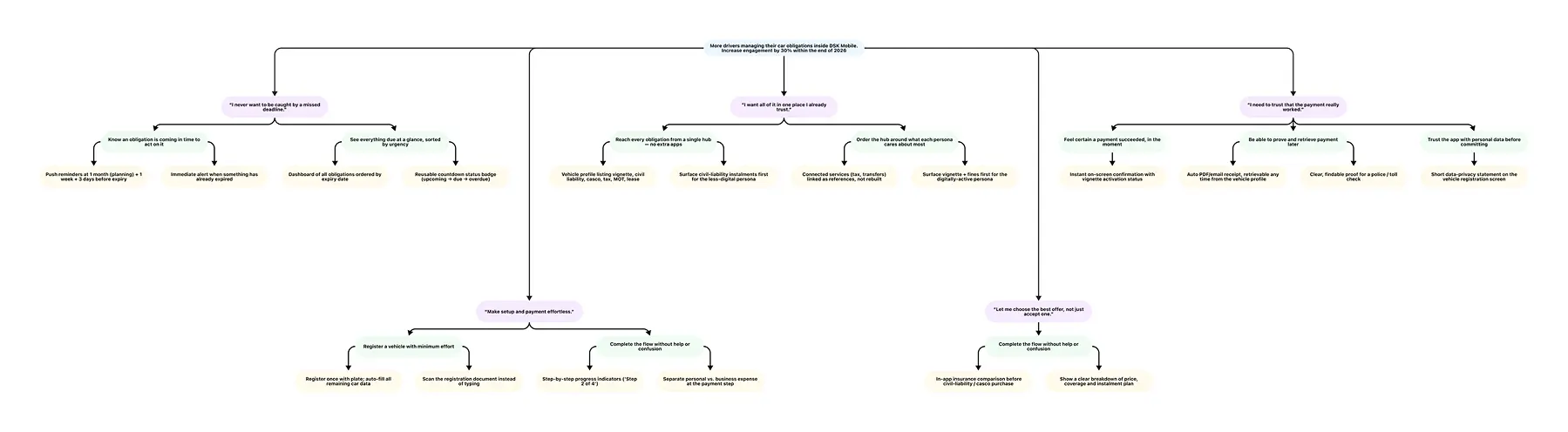
We set a goal at the top of the tree: to have more drivers manage their vehicle-related responsibilities through DSK Mobile, with engagement increasing by 30% by the end of 2026.
Listed under this goal are five opportunities, each of which is phrased in the way customers described their problems:
- “I never want to be caught by a missed deadline.” Push reminders one month and one week before expiry, an alert when something has already expired, and a dashboard sorted by due date.
- “I want all of it in one place I already trust.” A vehicle profile that lists the vignette, civil liability, casco, tax, inspection and lease, ordered around what each persona cares about most.
- “Make setup and payment effortless.” Register once with the plate and auto-fill the rest, scan the registration document instead of typing, and show step-by-step progress.
- “Let me choose the best offer, not just accept one.” In-app insurance comparison with a clear breakdown of price, coverage and installments.
- “I need to trust that the payment really worked.” Instant confirmation with the vignette activation status, and a receipt that can be retrieved any time from the vehicle profile.
Mapping the current experience
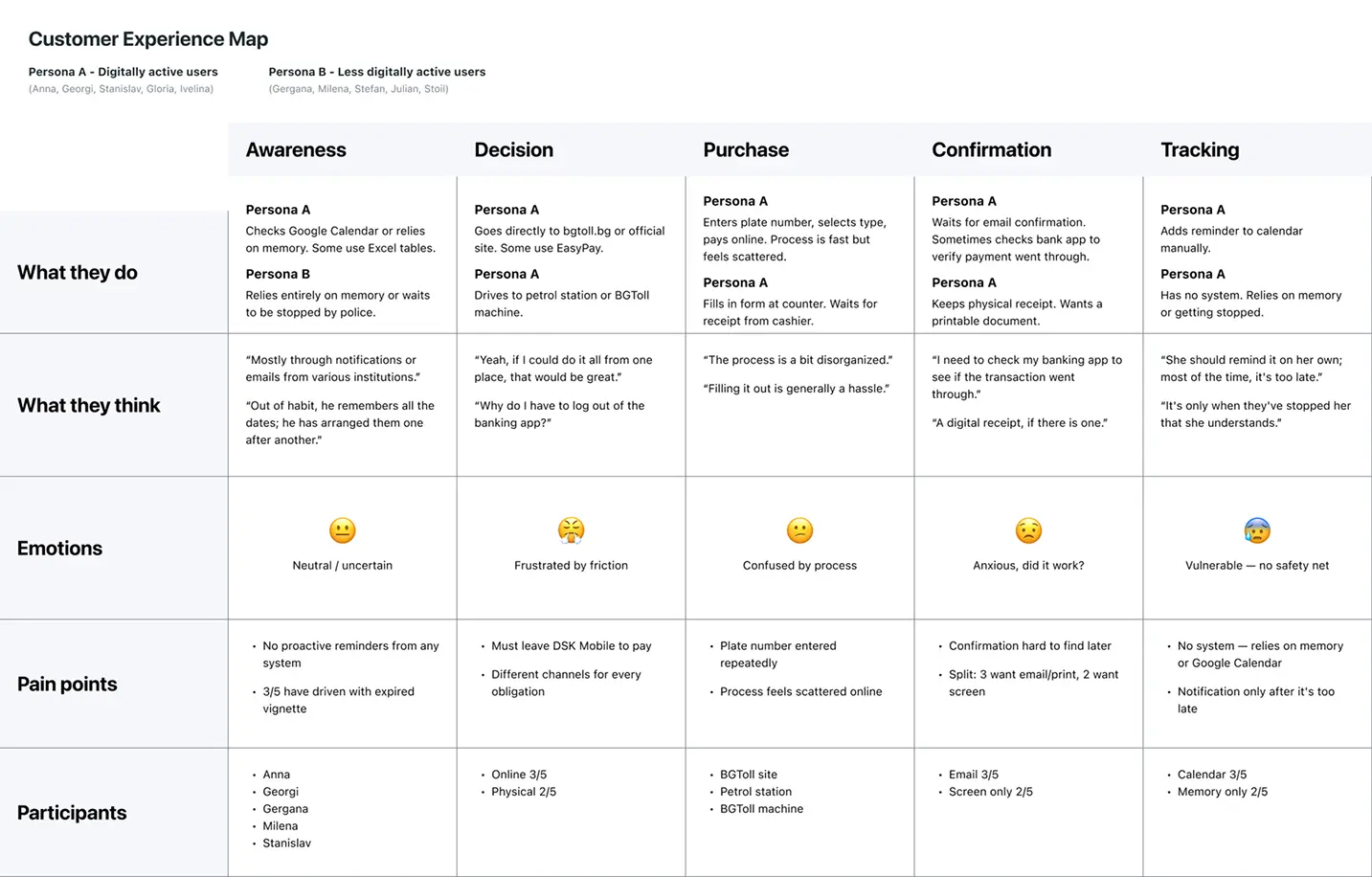
The user experience map tracked both personas through five stages: awareness, decision-making, purchase, confirmation, and follow-up. It revealed where emotions dipped and why.
Customers went from uncertainty to disappointment when they had to leave the banking app to pay; they felt confused by a process scattered across different websites; they worried whether the payment had gone through; and they had no assurance afterward.
Vehicle registration
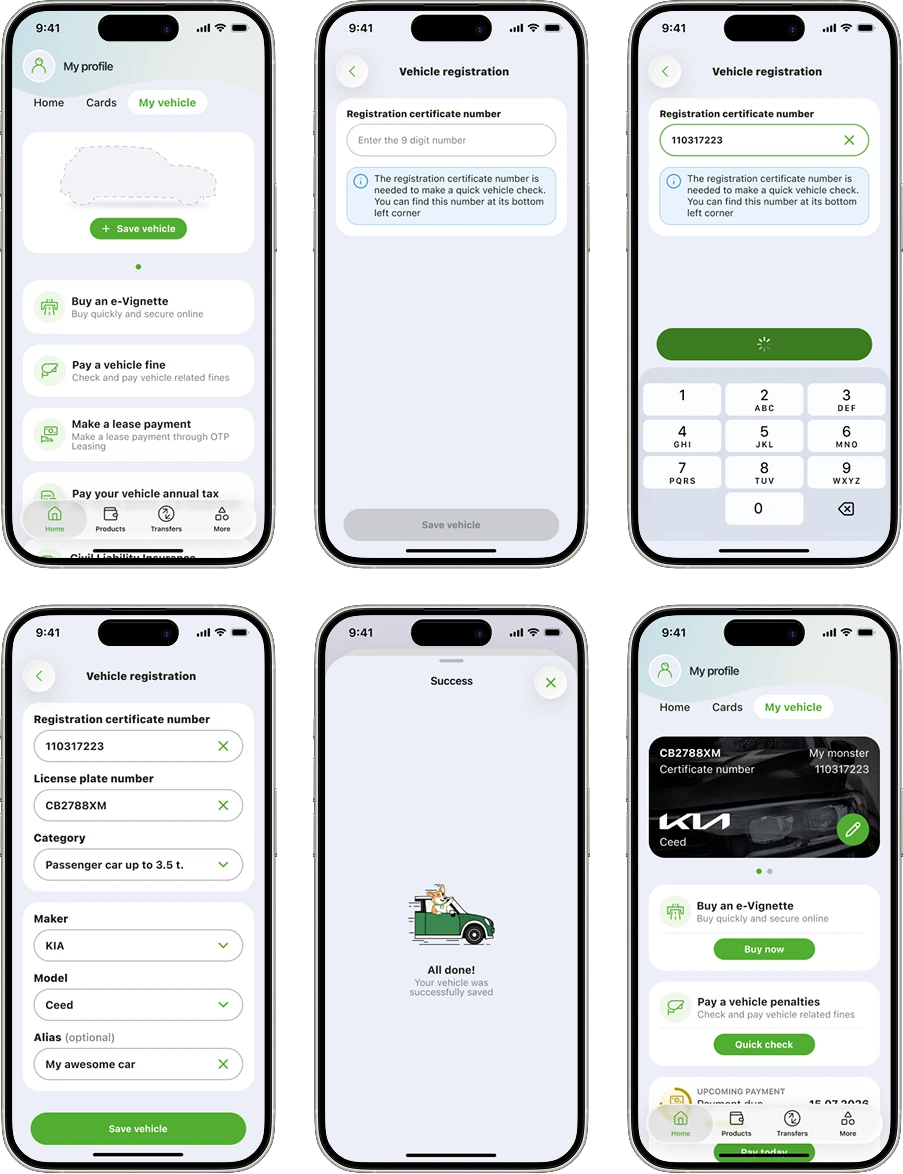
Registration is the foundation of the hub, so it had to be the easiest step.
The customer enters only the 9-digit registration certificate number, with a hint showing where to find it on the document. The app then fills in the plate number, category, maker and model from live government data. The customer only confirms, and can add an optional alias for the car.
After a short success state, the vehicle appears as a card on the new My vehicle tab, with the services and upcoming payments for that vehicle directly below it.
Buying an e-vignette
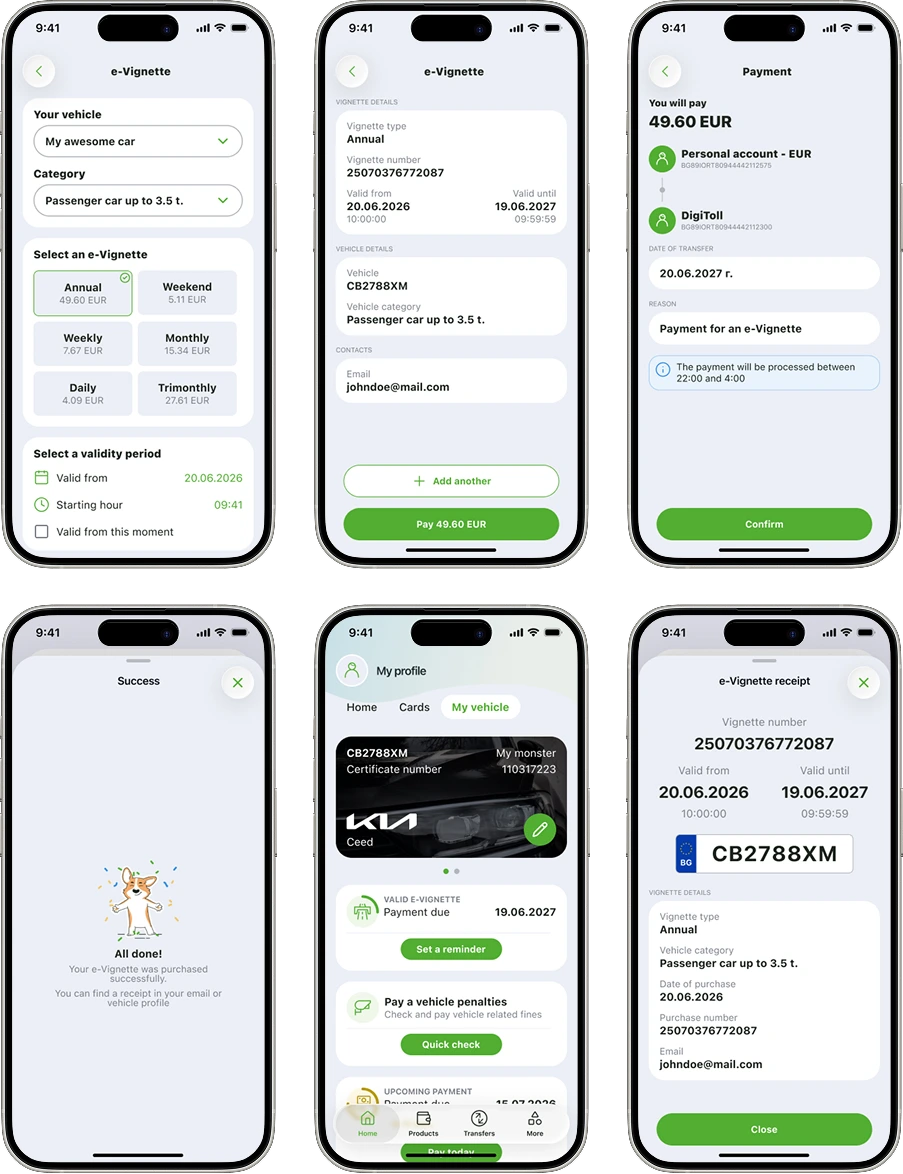
The e-Vignette was the first service we created. It was the most common request in interviews, and one where missed deadlines led directly to fines.
The process works whether or not the vehicle is registered.
A customer who has their vehicles saved selects a e-vignette from the list and goes through the rest of the process.
A customer who does not have a vehicle saved simply enters the license plate number and can check the “Save Vehicle” option to register it on the spot, which turns a one-time purchase into a starting point for the platform.
From there, the customer picks the vignette type (annual, weekend, weekly, monthly, daily or trimonthly), sets the validity start or chooses “valid from this moment”, reviews the details and pays from a DSK account.
The confirmation answers the trust question from the research: the success screen says where to find the receipt, the vehicle card updates at once to show a valid e-vignette with its expiry date and a “Set a reminder” button, and the full receipt with the vignette number and validity period stays available in the vehicle profile and by email.
Reflection
The value of discovery
Ten interviews changed what we built. Our starting assumption was that customers wanted convenience. The research showed that trust mattered just as much: proof of payment, a clear data statement and reminders before a deadline, not after it.